
Why We Build in 14k Solid Gold
There is a question that comes up whenever someone is considering their first piece of fine jewelry: does the metal actually matter?
It does. But not for the reasons most brands will give you.
What is 14k solid gold?
14k solid gold is a gold alloy containing 58.3% pure gold, mixed with other metals — typically silver, copper, or zinc — to improve hardness and workability. That 58.3% figure is not arbitrary. It is the threshold at which gold retains its warmth, color, and value while becoming durable enough for daily wear.
Unlike gold-plated or gold vermeil jewelry, which has only a thin layer of gold over a base metal, 14k solid gold is the same material all the way through. There is no plating to wear away. What you see on the surface is what the piece is made of.
The 14k proportion is a design decision.
Pure gold — 24 karat — is soft, warm, and vivid. It bends too easily for everyday wear, which is why it has always been mixed with other metals to create an alloy strong enough to hold its form. The question is how much. 18k gold contains 75% pure gold; 14k contains 58.3%. The difference is not purely technical — it shapes how the piece sits, moves, and wears.
14k gold has a particular quality: slightly cooler in tone than 18k, with a precision that suits restrained, structural design. The pieces are built on it, not despite it.
14k vs 18k gold jewelry.
The most common comparison is 14k versus 18k. 18k gold is richer in color — the higher gold content gives it a deeper, warmer yellow. It is also slightly softer, which matters for everyday pieces that take real wear: rings, bangles, pieces worn against other surfaces.
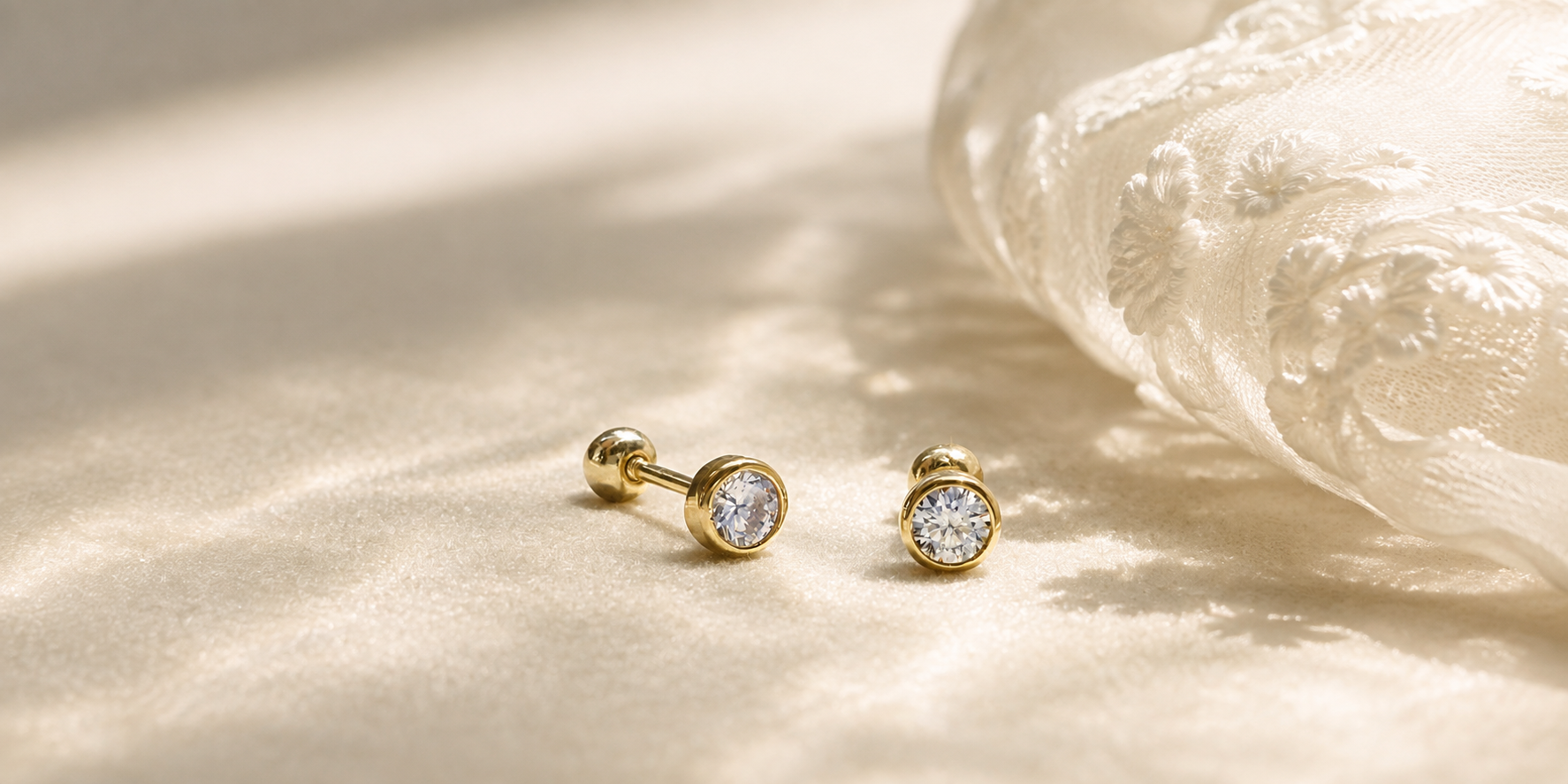
14k gold is harder, cooler in tone, and — because it contains less pure gold — more accessible in price. For pieces designed to be worn daily and to last, it is often the better material choice. The color difference is subtle to most eyes; the durability difference is not. The Solitaire Drops Single Stud, for instance, reads as precise rather than heavy — which is exactly the effect 14k enables.
We design in 14k because the aesthetic suits our pieces. The fact that it is more hardwearing is a secondary argument, but a good one.
On recycled gold.
Every piece at Frida and Florence is made in 100% recycled gold. We mention this not as a sustainability credential — recycled gold has the same chemical properties as virgin-mined gold, and we have no interest in marketing it as a moral position. We mention it because it is the more intelligent material decision: the same longevity, the same warmth, the same quality, without new extraction. That is what conscious integrity looks like in practice.
We work directly with the RJC-certified factory from Hong Kong. We know exactly what goes into each piece and where it comes from. That is not a small thing in an industry where material traceability is rarely straightforward.
Does 14k solid gold tarnish?
No. Gold does not tarnish — it is chemically stable and does not react with oxygen or moisture the way silver or copper does. A piece in solid 14k gold jewelry will look like itself in 10 years, or 20.
What solid gold does develop over time is patina — a very slight softening of surface brightness that comes from wear. This is different from deterioration. Patina is character.
Most people find that a piece worn daily looks better at 5 years than it did at 5 days.
This is the practical distinction from gold-plated and gold vermeil pieces: they require upkeep that solid gold does not. The plating wears through to the base metal within months of daily wear. The piece that looked identical to a solid gold ring 6 months ago no longer does. This is not a criticism of plated jewelry — it is a clarification of what you are choosing when you choose solid gold. You are choosing something that will not ask you to think about it again.
How to care for 14k solid gold jewelry.
14k solid gold requires very little maintenance. Wipe pieces down occasionally with a soft, dry cloth to remove oils and residue. For a deeper clean, warm water and a small amount of mild soap — rinsed thoroughly and dried completely — is sufficient. Store pieces separately to prevent surface scratching, particularly rings and bangles that sit against each other.
Beyond that, there is not much else to do. The point of solid gold is that it largely takes care of itself.
How to build a set in 14k solid gold.
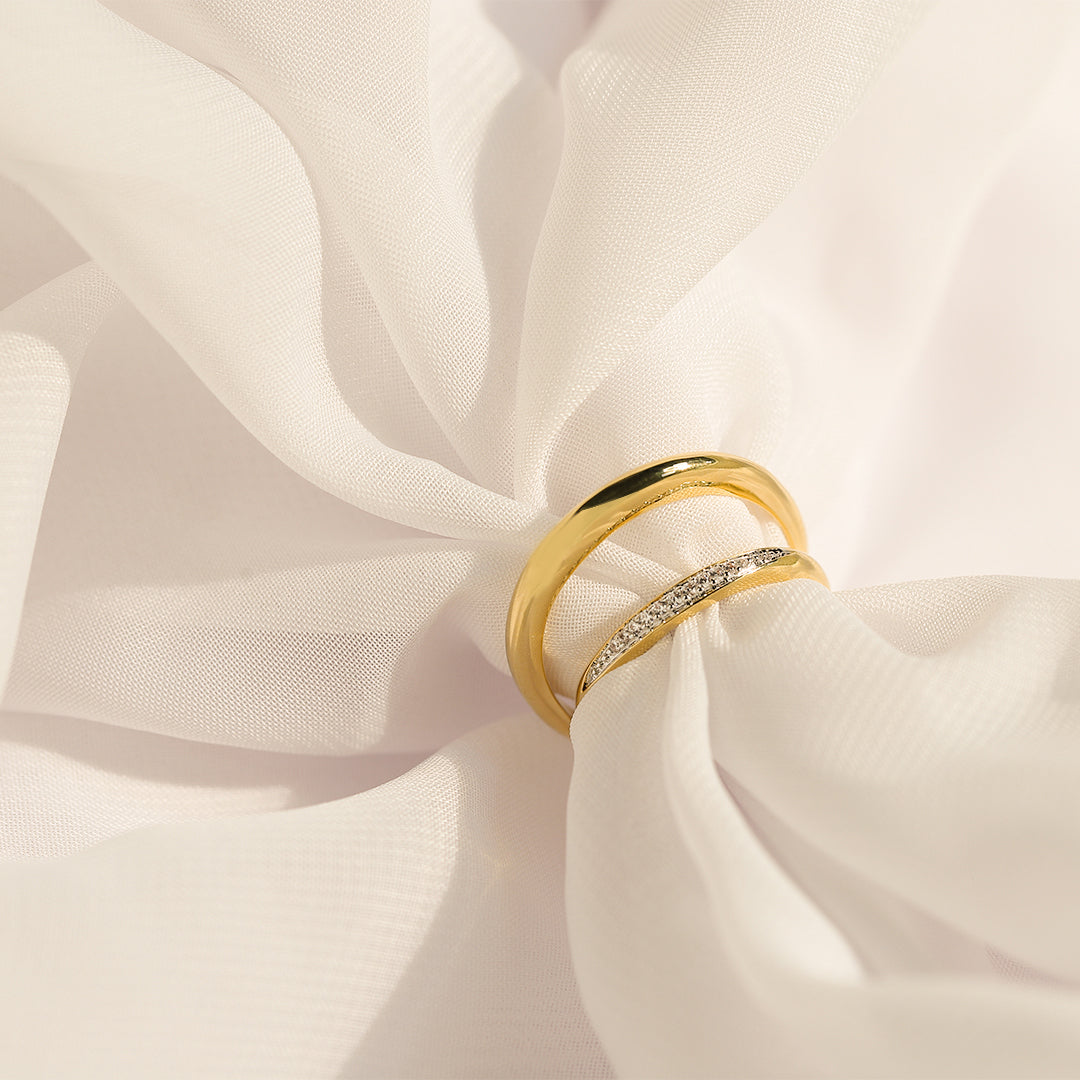
Because 14k solid gold is consistent — the same warm, slightly cooled tone across every piece — items from different collections wear well together. A Moonlight Single Stud alongside a Royal Radiance Hoop. A plain band and a sculptural ring. The material creates coherence; the designs handle the contrast.
The pieces are designed to accumulate this way. Not as a matched set in the traditional sense, but as something more considered — each piece chosen deliberately, each one still making sense in five years' time. That is the practical case for 14k solid gold jewelry.
The aesthetic case is the same. Shop the Solid Gold collection.


Written by The FF Team

Leave a comment
This site is protected by hCaptcha and the hCaptcha Privacy Policy and Terms of Service apply.