
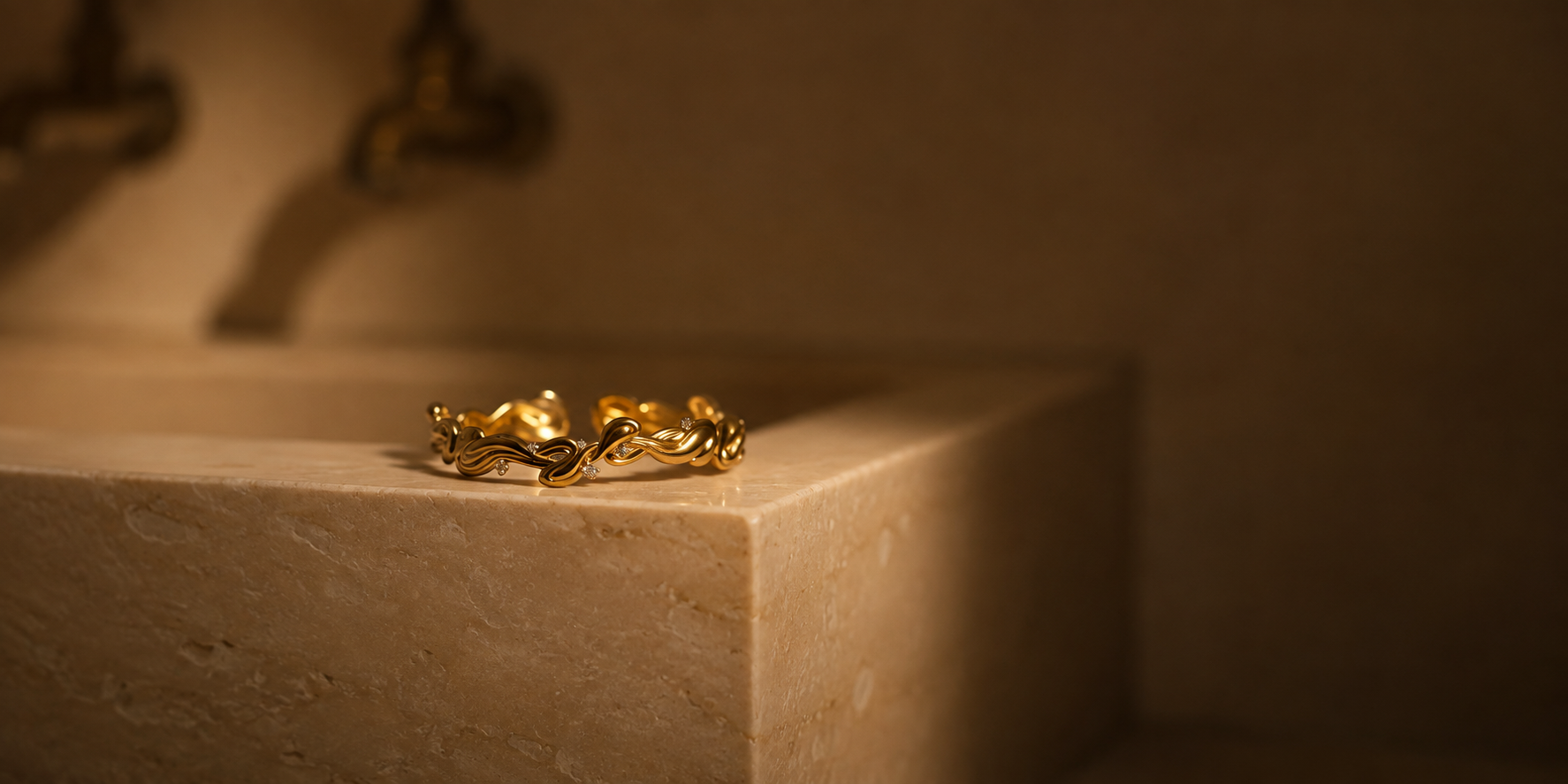
The Intersection of Jewelry and Sculpture in Wearable Art
There is a particular quality to a piece of jewellery that makes you want to hold it before you wear it. Not to inspect the clasp or check the size — but to look at it properly. To understand it as an object.
That quality — the sense that something has been designed to be seen before it is worn — is the line between jewellery and sculpture. And it is thinner than most designers acknowledge.
At Frida and Florence, we design at that line deliberately. Our collections are built at the convergence of two distinct artistic traditions: Korean design, with its emphasis on restraint, proportion, and the considered use of negative space; and the European fine arts tradition, which prizes material integrity, the persistence of form, and the idea that craft is a language in its own right.
The result is jewellery that holds its own as sculpture. Not in a maximalist sense — not as a piece that announces itself from across the room — but in the quieter, more enduring sense: something that reveals itself differently each time you look at it, something that would still be interesting if it were never worn at all.
What Makes Jewellery Sculptural?
The distinction is not about scale or drama. A sculptural piece of jewellery is not necessarily large or bold. What defines it is the relationship between form and intention — the sense that the shape is doing specific work, not merely decorating.
Three things tend to separate sculptural jewellery from conventional fine jewellery. First, negative space: the gaps, the voids, the areas where no metal exists — treated as deliberately as the metal itself. Second, material honesty: a refusal to disguise what something is made from, or to use ornament to conceal the structure. Third, object logic: the piece should hold its coherence independent of the body wearing it. It should make sense sitting on a table.
Wearable art jewellery in the truest sense applies all three. The Wave, Pollock, and Inweave collections from Frida and Florence were each built with this logic — though each expresses it differently.
Wave Collection: Movement Fixed in Metal

The Wave collection begins with the most elemental visual metaphor in art history and asks what it looks like when you make it wearable.
Water doesn't just have movement — it has memory. The arc of a wave carries the energy of everything that preceded it: the weather, the depth of the water, the shape of the sea floor. When you freeze that arc in metal, you are not making a decorative pattern. You are capturing a state.
Each piece in the Wave collection translates that energy into precious metal. Rings curve like a waterline at rest. Bangles meet where two arcs converge with the precision of a tide's edge. The silhouette is clean — the Wave collection sits firmly in the Korean design tradition of restraint and proportion — but the emotional register is fluid, soft, and immediate.
This is sculptural jewellery in its oldest form: a shape that carries more meaning than its dimensions would suggest. The wave has been a motif in East Asian art for centuries, representing both the persistence of movement and the idea that the same force takes a thousand forms. Wearing a Wave piece is not a reference to that history — it is a continuation of it.
The Wave collection is where most people begin with Frida and Florence. The design language is legible without being obvious, and that balance — the feeling of recognizing something you've never seen before — is the hardest thing to achieve in wearable art jewellery.
Pollock Collection: Controlled Spontaneity

Where the Wave collection is fluid and deliberate, the Pollock collection introduces a different kind of energy. Named for the gesture at the heart of abstract expressionism, these are pieces where mark-making becomes metalwork.
Jackson Pollock's genius was not chaos. It was the decision about when to stop. His drip paintings are not accidents; they are records of an action taken with full awareness of its consequence. The Pollock collection operates on the same principle: each design captures a moment of movement — a mark, a drip, an arc of energy — translated into the precise and demanding language of fine jewellery.
The effect is striking because it is unresolved in the way that all good abstract art is unresolved. A Pollock piece does not have an obvious reading. Different wearers will describe the same piece differently, which is exactly as it should be.
In practical terms, this makes the Pollock collection the most versatile of the three. Because the forms are abstract rather than representational, they sit as well against a tailored work outfit as they do with something informal. The pieces do not code as formal or casual — they code as considered. That distinction matters.
This is wearable art in the most literal sense: jewellery that carries the energy of a gesture, fixed permanently in recycled gold and silver, worn against skin rather than hung on a wall.
Inweave Collection: Structure as Symbols

The Inweave collection is perhaps the most architecturally rigorous of the three. Where Wave works with movement and Pollock with gesture, Inweave works with structure itself — the interlocking of forms as a visual language for connection, tension, and unity.
Each piece is designed so that the negative spaces carry as much weight as the metal. The gaps are as considered as the form. Remove the empty space from an Inweave piece and the design collapses — the void is load-bearing. This is sculptural jewellery in the most architectural sense: pieces whose logic would hold at any scale, objects that could be modelled as maquettes and would still be worth looking at.
There is also a symbolic register to the collection that sits naturally alongside its formal rigour. Interlocking structures have meaning across cultures — connection, interdependence, the idea that two things become stronger for meeting each other. At Frida and Florence, the design itself is the product of exactly that: Korean design sensibility interlocked with European craft standards. The Inweave collection is, in that sense, the most autobiographical expression of what the brand actually is.
The collection appeals to a particular kind of wearer — someone who wants to understand how something was made before they decide whether to wear it, who will turn a piece over in their hands and notice that the underside was finished with the same care as the top.
The Materials Matter
Sculptural jewellery asks to be looked at closely, which means the material cannot hide. This is why we work exclusively with recycled gold, recycled sterling silver, and recycled brass — not as an activist position, but as a design one. A material with integrity behaves with integrity. It catches light consistently, ages honestly, and does not depend on surface treatment to look like something it is not.
All Frida and Florence pieces are produced in our RJC-certified factory in Hong Kong, to the quality standard that the designs demand. A piece designed to the logic of sculpture cannot be produced carelessly — the form only works if the execution is precise.
Worn Between Worlds
The phrase "wearable art jewellery" has been used so often it risks meaning nothing. What it should mean — what it means at Frida and Florence — is that a piece retains its integrity as an object independent of the body wearing it. The art is not diminished by the wearing. The wearing is not a concession to the art.
Our pieces are designed by Korean designers working to European quality and aesthetic standards. The design sensibility and the material standard come from different traditions, which means every piece is made at an intersection before it is ever worn at one. "Worn between worlds" is not a tagline. It is the literal truth of how these objects come into existence.
The Wave, Pollock, and Inweave collections are our clearest expression of that idea: sculptural jewellery that makes sense as art and as everyday wear — because for the women who choose it, there was never a contradiction between the two.
Explore the Wave collection, Pollock collection, and Inweave collection.


Leave a comment
This site is protected by hCaptcha and the hCaptcha Privacy Policy and Terms of Service apply.